

Quad Cortex Worship Presets for Guitar and Bass: David Liotta, Samuel Rady, and David Kim
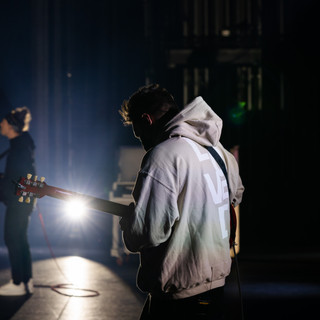
You finally did it. The pedalboard is listed on Marketplace, the Quad Cortex is sitting on your floor, and you've scrolled through every stock preset looking for your Sunday sound.
If you're anything like me, you found plenty that sound amazing on their own and not one that sounds like the parts on the records you actually play. That's not a knock on the stock presets. They're built to show off everything the Quad Cortex can do, not to sit under a vocal in a worship set.
Full disclosure: I'm a pedalboard guy. I've had the privilege of playing guitar for Anne Wilson, Stars Go Dim, Bethel Music, Jason Upton, Worship Online, and others, and my favorite tones have always come from pedals into an amp into good mics. But I also know exactly why one-box rigs win so many stages.
One night Leeland borrowed my board in front of about fifteen thousand people. A tired patch cable killed his audio mid-song, and he called me up on stage to fix my own pedalboard in front of everyone. Then it cut out again during our set later that night.
My lesson was "get proper soldered cables," but I completely understand the person whose lesson was "carry fewer of them." Read the full story here.
That's the real case for a Quad Cortex: fewer cables, fewer things to fail, and the same rig every night. The hard part is getting it to sound like the record, and that's where starting from a working player's preset saves you a lot of Saturdays, whether you play guitar or bass.
What makes a Quad Cortex preset work on Sunday
The Quad Cortex does two different things, and good presets respect both. It runs modeled amps whose knobs behave like the circuit, and it runs Neural Captures, which are a snapshot of one real amp at one setting.
Captures sound fantastic, but they're static. Turn the gain way past where the capture was made and you're asking DSP to guess.
The other trap is volume. A preset dialed quietly in a bedroom will sound thin at performance level, because your ears hear lows and highs differently when it's loud. The presets that hold up on Sunday are built by people who dialed them where they actually play them.
Worship guitar: David Liotta's one preset for the whole set
David Liotta is best known for his work with Elevation Worship. He played on albums like Graves Into Gardens and the Grammy-winning Old Church Basement, and co-produced Graves Into Gardens: Morning & Evening.

His Quad Cortex pack is exactly one preset, called All Day Every Day. It runs in Stomp mode, so it plays like a pedalboard:
A compressor that stays on
Three drives
Stereo chorus
Two delays and two reverbs, each on its own footswitch
In David's own words from the product page: "This is the preset I use every day both in the studio and live. Whether I'm playing worship music, pop or country this preset gives me what I need."

Why one preset works
If you're coming off a board, Stomp mode is the friendliest way into a Quad Cortex. You're stepping on drives and delays like you always have, not hopping between presets mid-song and hoping the tails survive.
The amps are two free Tone Junkie captures, the 65 Deluxe N Clean and the 66 AC30 NRM Clean, plus a free drive capture from hstrasser. All three come bundled with the preset, so there's nothing extra to hunt down.

Worship bass: Samuel Rady's Quad Cortex bass presets
Samuel Rady has played on more than 250 live and studio recordings. He started his touring career with Maverick City Music and is on the road now with Kameron Marlowe.

His Quad Cortex Bass Presets are built around context, which is how working bassists actually think:
A touring preset with MicroSynth, a drive, a sub, and a boost for switching basses, plus transpose scenes for standard, half step, whole step, and five string
A church preset for modern worship sounds, with a heavier drive, a low pass filter for the down sections, and chorus for the moments that open up
A studio preset that sends bass and effects out one output and a straight clean tone out the other, so the producer has options later
A recreation of the preset Samuel used touring with Maverick City, kept deliberately simple
A flatwound preset with spring reverb for pick playing, and a synth bass preset for nights with no Moog on stage
There are also dual-path versions that let you run a synth bass through Input 2 and Output 2 at the same time as your bass. All together, that's ten presets.

About that Noble capture
The pack includes a capture of Samuel's own Noble preamp and his Lightspeed drive. The Noble is famous for feel and depth in your in-ears, not for EQ, so think of the capture as Samuel's preamp at his settings, a foundation you play on rather than a tone control you dial.
Worship bass lives dry and mid-forward. Start with the church preset, keep your mids, and save the synth moment for the bridge.

If you're on an HX Stomp instead, Samuel made a Stomp version of the pack too.
Free guitar presets: David Kim
David Kim is a Los Angeles guitarist who plays across CCM, pop, R&B, and gospel, with credits alongside Jackson Wang, Ciara, and Doobie Powell.

His Quad Cortex Presets are eight patches and they're free. You get a clean foundation with a compressor stack, a shimmer and reverse delay swell for slow builds, a POG-style octave lead, and a square-wave chopper tremolo for pop builds. It's the easiest way to hear what a player-built QC preset feels like before you spend anything.

The best rig is the one you stop thinking about the second the count-in starts.
How Cortex Cloud delivery works
Quad Cortex presets don't download as a file. We share them to your Cortex Cloud account, and Cortex Cloud only shares between accounts that follow each other.

Make a free Neural DSP account and sign in on your Quad Cortex.
Follow thesoundshopco in the Cortex Cloud app or at cloud.neuraldsp.com.
Type your exact Cortex Cloud username at checkout, not your email.
Download the preset from Shared With Me. Its captures come along with it.
Presets arrive in under an hour, usually faster. If you followed thesoundshopco before you bought, it's usually two to three minutes. The full walkthrough is in our Quad Cortex guide.
Dialing any QC preset for your room
A few habits the direct-to-front-of-house players swear by:
Dial at performance volume. The same preset at bedroom level lies to you.
Leave the Global EQ flat, so you have an escape hatch for a strange room.
Ask your sound engineer how it sounds out front before you start changing things. Your in-ears aren't the whole story.
Check your preset in mono. Plenty of church systems sum everything to mono.
Quick answers
Do these presets work on the Quad Cortex mini?
Yes, they load on the Quad Cortex mini too.
What about the Nano Cortex?
No. The Nano Cortex can't load them.
Do I need to buy the captures separately?
No. David Liotta's and Samuel Rady's captures come bundled with their presets.
Will it sound exactly like the record?
It'll sound like the player's actual rig, which is a real head start. Your guitar, your pickups, and your room still get a vote, so expect to adjust a few things.
I'm still on a pedalboard. Should I switch?
Only if it solves a real problem for you. Plenty of great players are sticking with their boards, and both rigs are on the biggest stages in the world right now. If you're still deciding, we wrote about choosing between a multi-FX unit and a pedalboard.
Whatever you carry on Sunday, the goal is the same. Get the gear out of your head so you can listen to the room, the band, and the people you're leading.
Go make something beautiful.
Hear every demo and pick your starting point in our Quad Cortex presets.


